
Green Hydrogen: India’s Roadmap to a Sustainable Energy Future
India stands at a defining moment in its energy journey. As the world’s third-largest energy consumer, the country must balance rapid economic growth, rising energy demand, and its responsibility to reduce carbon emissions. While renewable energy has already transformed India’s power sector, the next phase of decarbonisation requires solutions that go beyond electricity alone.
This is where green hydrogen emerges as a game-changer.
Backed by strong policy intent, abundant renewable resources, and growing industrial demand, green hydrogen has the potential to reshape India’s energy ecosystem—especially for sectors that are difficult to electrify. This blog explores what green hydrogen is, why it matters for India, current progress, challenges, and the road ahead.
India’s Energy Landscape: Opportunities and Challenges
India’s energy system is diverse and complex. Coal continues to dominate electricity generation, accounting for more than half of total consumption. At the same time, India imports nearly 85% of its crude oil, making energy security a persistent concern.
Despite these challenges, India has made remarkable progress in renewables:
- One of the world’s largest solar power programs
- Ambition to achieve 500 GW of non-fossil energy capacity by 2030
- Falling solar and wind tariffs, among the lowest globally
Yet, challenges remain:
- Grid integration and energy storage
- Dependence on fossil fuels for industrial heat and feedstock
- Emissions from steel, cement, fertilisers, and transport
- Ensuring a just transition for coal-dependent regions
What Is Green Hydrogen?
Hydrogen is a versatile energy carrier, but not all hydrogen is clean.
- Grey hydrogen is produced from natural gas, emitting CO₂
- Blue hydrogen captures some emissions but still relies on fossil fuels
- Green hydrogen is produced by splitting water using renewable electricity
Green hydrogen is carbon-free at the point of production, making it one of the cleanest fuels available today.
How Green Hydrogen Is Produced
The core process behind green hydrogen is electrolysis, where electricity splits water (H₂O) into hydrogen (H₂) and oxygen (O₂).
Key Electrolysis Technologies
Alkaline Electrolysis (AEL)
- Mature and cost-effective
- Suitable for large-scale operations
- Lower flexibility with variable renewables
Proton Exchange Membrane (PEM) Electrolysis
- Higher efficiency
- Responds well to fluctuating solar and wind power
- Higher capital cost
Solid Oxide Electrolysis (SOEC)
- Operates at high temperatures
- Very high efficiency
- Still in early commercial stages
As renewable electricity costs continue to fall, green hydrogen production becomes increasingly viable at scale.
Key Applications of Green Hydrogen
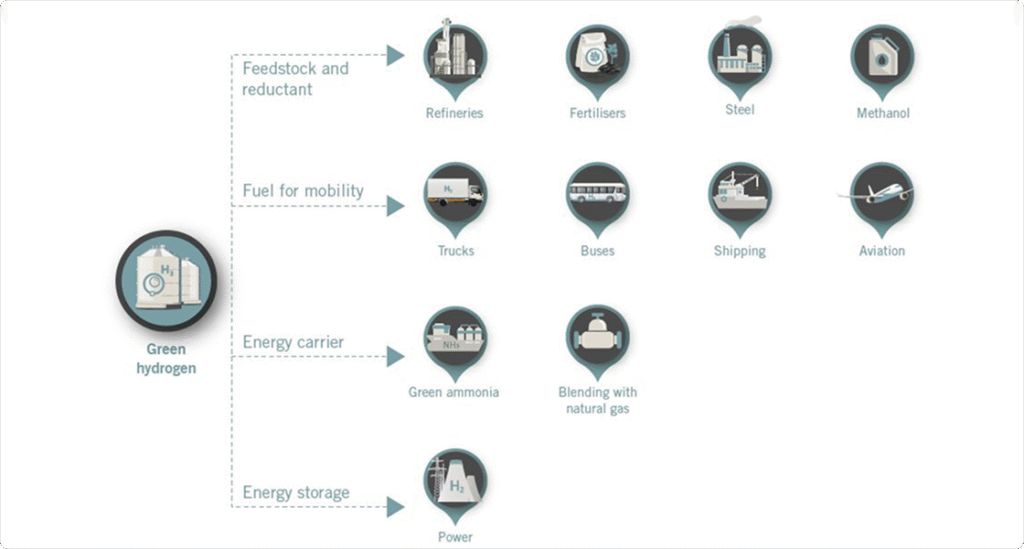
Green hydrogen’s true value lies in its versatility. It can act as a fuel, feedstock, and energy storage medium.
Decarbonising Heavy Industry
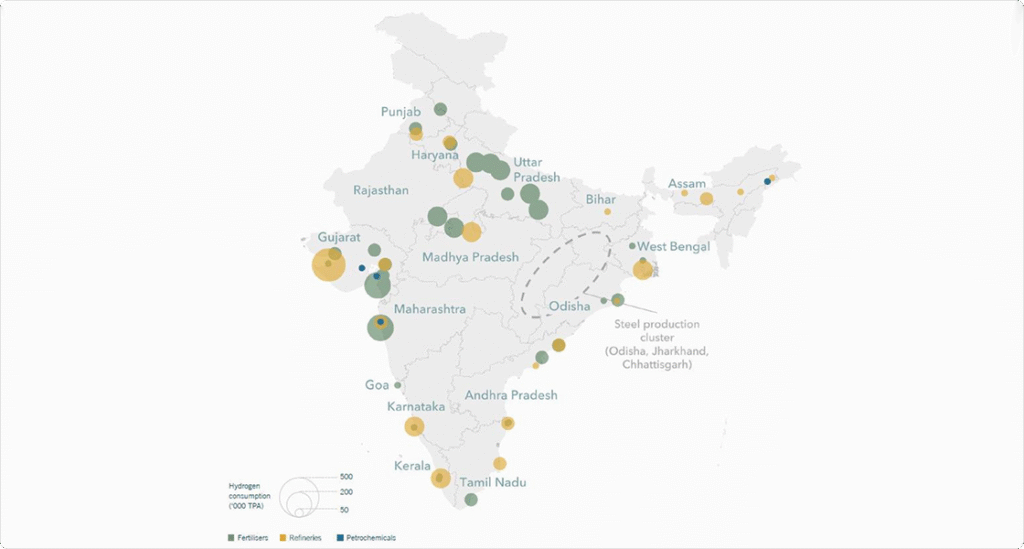
Industries like steel, cement, refineries, and fertilisers require high temperatures and chemical reactions that electricity alone cannot replace.
- Hydrogen can replace coal in steelmaking
- Green hydrogen can substitute grey hydrogen in fertiliser production
- Enables low-carbon industrial processes
Clean Transportation
While electric vehicles dominate light transport, hydrogen is better suited for:
- Long-haul trucks
- Buses and heavy machinery
- Maritime shipping
- Aviation (via hydrogen-derived fuels)
Hydrogen fuel cells offer faster refuelling and longer range compared to batteries.
Energy Storage and Grid Stability
Renewable energy is intermittent. Green hydrogen enables:
- Storage of excess solar and wind power
- Seasonal energy storage
- Grid balancing during peak demand
This makes hydrogen a critical enabler for high renewable penetration.
Green Ammonia and Emerging Uses
- Fertiliser production
- Zero-carbon shipping fuel
- Blending with natural gas
- Industrial heating
India’s Green Hydrogen Potential
India is uniquely positioned to scale green hydrogen due to its natural resources, industrial demand, and policy momentum.
Abundant Renewable Energy
- 300+ sunny days annually
- High solar irradiation in Rajasthan, Gujarat, and Maharashtra
- Strong wind potential in Tamil Nadu, Gujarat, and coastal regions
This allows India to produce green hydrogen competitively using domestic energy.
Economic Opportunities
Green hydrogen can:
- Reduce fossil fuel imports
- Create new manufacturing ecosystems (electrolysers, fuel cells)
- Generate skilled jobs
- Enable green exports to global markets
It also strengthens India’s position as a clean energy leader.
Environmental Benefits
- Zero greenhouse gas emissions during production
- Reduction in air pollution
- Supports India’s Paris Agreement commitments
- Improves public health outcomes
Current State of Green Hydrogen in India
India’s green hydrogen ecosystem is still in its early stages but gaining momentum rapidly.
Government Initiatives
The National Green Hydrogen Mission is a cornerstone of India’s strategy. Key objectives include:
- Establishing India as a global hydrogen hub
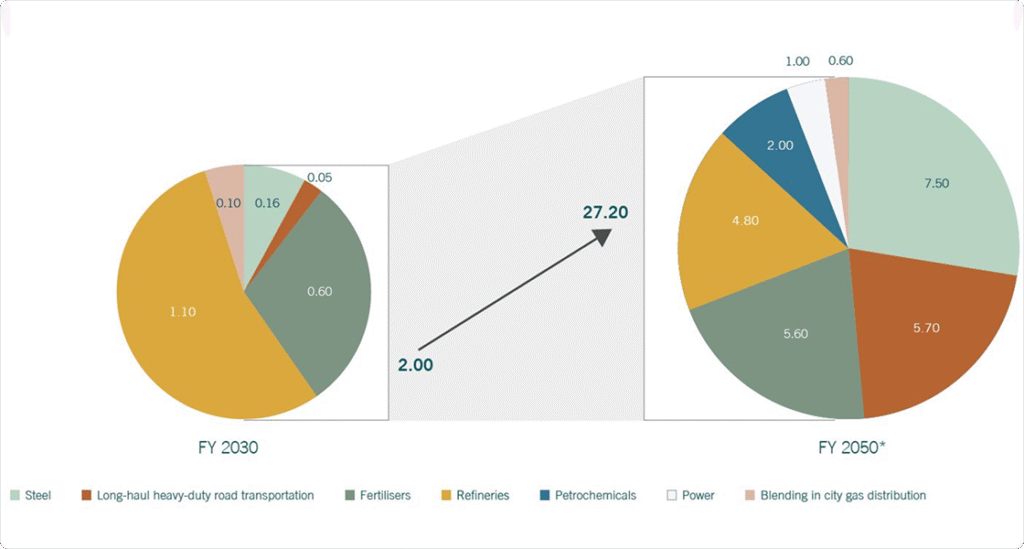
- Producing 5 million metric tonnes of green hydrogen annually by 2030
- Supporting domestic electrolyser manufacturing
- Incentives for renewable-powered hydrogen projects
Recent policy measures include transmission charge waivers, land availability, and production incentives.
Industry and Pilot Projects
Major public and private players are actively involved:
- NTPC’s hydrogen mobility projects
- IOC and GAIL pilot plants
- Reliance’s large-scale green hydrogen ambitions
- Steel and chemical companies exploring hydrogen integration
These pilots help validate technology, costs, and operational models.
Challenges Slowing Adoption
Despite strong potential, several barriers remain.
Technological Challenges
- High cost and efficiency limitations of electrolysers
- Hydrogen storage and transportation complexities
- Need for better fuel cell technologies
Infrastructure Gaps
- Limited hydrogen pipeline networks
- Need for refuelling stations and storage facilities
- Expansion of renewable capacity to support electrolysis
Economic Viability
Green hydrogen is currently more expensive than fossil-based hydrogen. However:
- Costs are expected to fall with scale
- Technology learning curves are improving
- Policy support can bridge early-stage gaps
Regulatory Framework
Clear standards for safety, transport, storage, and certification are still evolving. A robust regulatory ecosystem is critical for investor confidence.
Strategies to Scale Green Hydrogen in India
Policy and Market Creation
- Production-linked incentives
- Mandated hydrogen usage in specific industries
- Carbon pricing mechanisms
- Clear long-term hydrogen roadmaps
Investment and Financing
- Public-private partnerships
- Green bonds and climate finance
- International funding and technology transfer
Research and Development
- Improving electrolyser efficiency
- Advancing hydrogen storage solutions
- Fuel cell innovation
- Demonstration and pilot projects
International Collaboration
Partnerships with countries like Germany, Japan, and Australia can accelerate:
- Technology transfer
- Standards alignment
- Export market access
Infrastructure Opportunities in the Green Hydrogen Ecosystem
As green hydrogen scales, infrastructure development becomes critical. Production plants, storage units, control rooms, and refuelling stations require:
- Temperature-controlled environments
- Fire-safe and durable structures
- Energy-efficient building solutions
High-performance insulated building systems play a vital role in ensuring operational efficiency, safety, and sustainability—especially in extreme climates and large-scale industrial facilities.
The Road Ahead
India’s green hydrogen journey is not just about clean energy—it is about economic resilience, industrial competitiveness, and climate leadership.
With the right mix of policy clarity, infrastructure investment, technological innovation, and global collaboration, green hydrogen can transform India’s energy system over the next two decades.
While challenges remain, the direction is clear. Green hydrogen will be a cornerstone of India’s sustainable energy future, enabling the country to decarbonise its economy while continuing to grow.
Final Takeaway
Green hydrogen is no longer a distant concept for India—it is a strategic priority. As production scales, costs decline, and infrastructure develops, green hydrogen will unlock new pathways for clean industry, transport, and energy security.
India’s success in this space could redefine its role in the global clean energy transition—moving from an energy importer to a net exporter of sustainable solutions.